
In this imaginative journey to the frontier of AI, we’ll project ourselves into the year 2912, where we will challenge the Data Analysis module of ChatGPT v4 to solve a space-time anomaly.
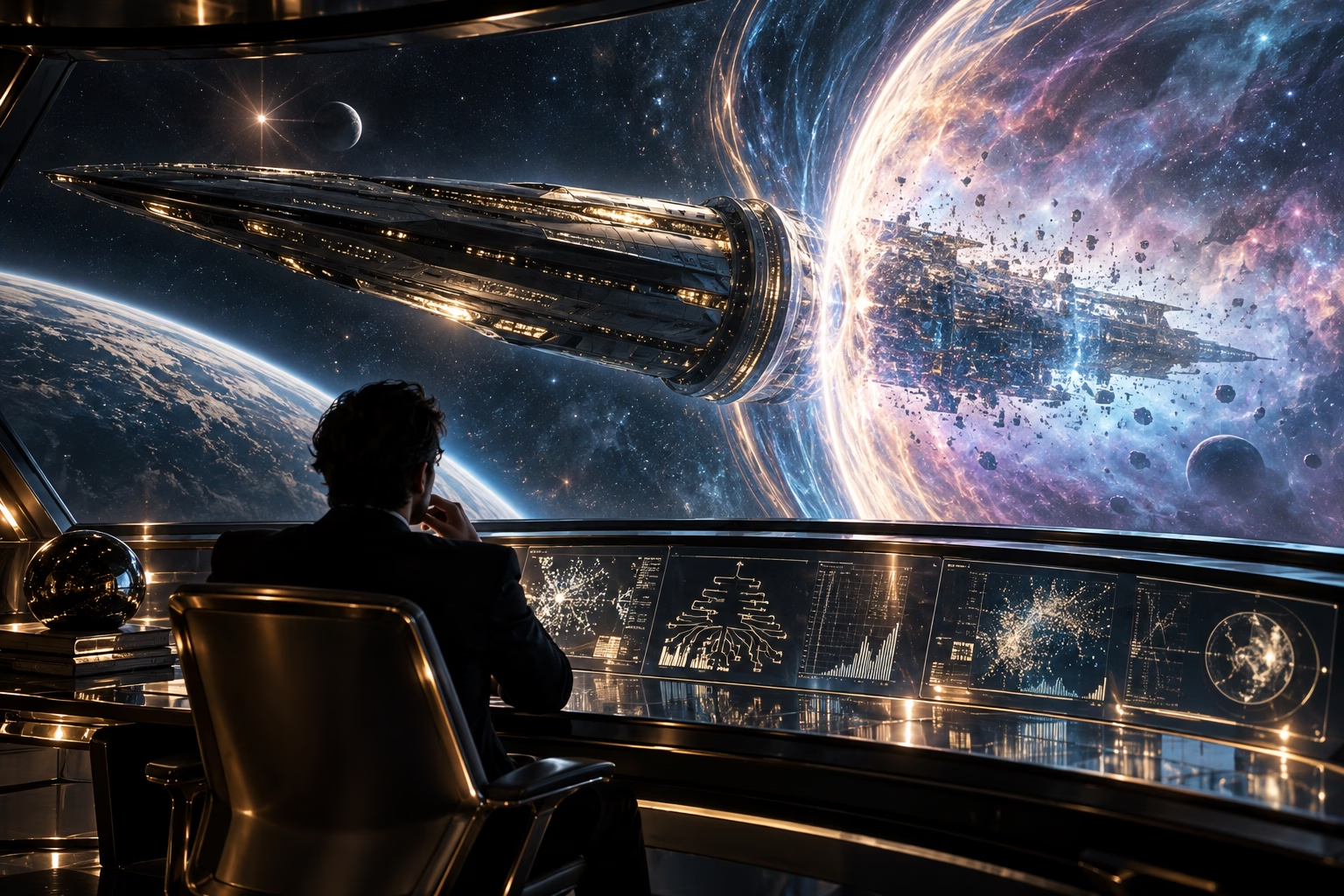
To break the ice, I asked ChatGPT to briefly describe, based on its knowledge, how it imagines humanity in the year 2912, especially in relation to intergalactic travel.
“By the year 2912, I envision humanity as a highly advanced civilization, spread across multiple planets and star systems. Thanks to discoveries in physics and bioengineering, humans are able to adapt to different space environments and have developed intergalactic travel technology that allows crossing vast cosmic distances in a short time. Spacecrafts are elegant and sophisticated, equipped with AI systems to assist and protect travelers. Human cultures are diverse, influenced by various space colonies, yet united by a common quest for exploration and knowledge.”
I share ChatGPT’s optimism, which doesn’t describe a dystopian future or conflicts, but collaboration among civilizations; probably a reflection of its algorithms’ optimism bias.
Now, let’s describe our intergalactic problem presented on Kaggle:
Addison Howard, Ashley Chow, Ryan Holbrook. (2022). Spaceship Titanic. Kaggle
The interstellar spaceship Titanic, on its maiden voyage, is transporting about 13,000 emigrants from our solar system to three newly habitable exoplanets. Passengers come from Earth, Mars, and Europa, some in cryogenic sleep. The ship offers various services, including VIP treatments, a SPA, a shopping center, and a high-tech Virtual Reality deck. All onboard activities are tracked by a next-generation computer system.
Near Alpha Centauri, en route to the torrid 55 Cancri E, the ship encounters a space-time anomaly hidden by a dust cloud. After 1,000 years, it seems the tragedy of the previous Titanic is repeating in space.
After the impact, although the ship remains miraculously intact, nearly half the passengers are teleported to an alternate dimension!

To aid rescue teams and recover the missing passengers, we must predict which passengers have been teleported using data from the damaged computer system.
Here’s where we come in with the assistance of ChatGPT v4 and its Data Analytics module.
We face a synthetic problem, created in the lab, which I consider extremely valid and complete to delve into various themes related to data analysis and machine learning algorithms.
To effectively solve these types of problems typically requires complex theoretical and programming knowledge. ChatGPT assists the operator by guiding through all stages of the process.
Here are the details of the Spaceship Titanic problem:
We start with a training file containing data on two-thirds of the passengers and information on whether they have been teleported, and a test file with the same data but no information on the remaining passengers’ teleportation status.
The challenge is to predict, as accurately as possible, whether the passengers in the test file will be teleported.
Here are the known passenger data.
CAMPO DESCRIZIONE PassengerId A unique ID for each passenger, in the format gggg_pp where gggg indicates a group the passenger belongs to and pp is the passenger number within the group. HomePlanet The planet the passenger departed from, usually their permanent residence planet. CryoSleep Indicates whether the passenger chose to be put in suspended animation for the journey. Cryosleep passengers are confined to their cabins. Cabin The cabin number where the passenger is located. Presented in the format deck/number/side, where the side can be P for Port (left) or S for Starboard (right). Destination The planet where the passenger disembarks. Age The passenger’s age. VIP Indicates whether the passenger paid for a special VIP service during the trip. RoomService Amount the passenger charged to room service. NameThe names and surnames of the passenger.TransportedIndicates whether the passenger has been transported to another dimension. This is the target variable, the column we are trying to predict. FoodCourt Amount the passenger charged to the food court. ShoppingMall Amount the passenger charged to the shopping center. Spa Amount the passenger charged to the spa. VRDeck VRDeckAmount the passenger charged to the virtual reality deck. Name The name and surname of the passenger. Transported Indicates whether the passenger has been transported to another dimension. This is the target variable, the column we are trying to predict. known passenger data
I attempted to solve the problem using ChatGPT v. 4.0 utilizing its Data Analysis module.

After presenting the training file, ChatGPT reprocessed it in the best way and also proposed the best strategies for managing missing data.
Spoiler Alert if you want to tackle this problem without any information.
I asked ChatGPT to explain how these variables might influence the Target Transported variable, and here’s the response:
CHATGPT RESPONSE — SPOILER ALERT —
Predicting whether a passenger has been teleported or not is based on analyzing various factors (or variables) in the dataset. Here’s a brief summary of how some of these variables might influence the probability of being teleported:
HomePlanet (Planet of Origin): The probability of being teleported may vary depending on the passenger’s planet of origin. There could be specific trends or policies associated with each planet influencing this probability.
CryoSleep (Cryogenic Sleep): Passengers in cryogenic sleep may have a higher probability of being teleported, perhaps due to specific procedures or protocols related to their state.
Cabin (Cabin): The type or location of the cabin might correlate with the probability of being teleported, perhaps due to proximity to specific teleportation devices or areas of the spacecraft.
Destination (Destination): The final destination might influence the probability of being teleported, perhaps due to different procedures for different places or travel distances.
Age (Age) and VIP: Though with a weaker correlation, age and VIP status may play a role, potentially due to policies or preferential treatments for certain age groups or VIPs.
Expenses (RoomService, FoodCourt, etc.): Expenditures in various categories (like RoomService, FoodCourt, etc.) show a correlation, suggesting that a passenger’s spending behavior might be linked to their probability of being teleported.
It’s important to note that these are correlations observed in the data and do not necessarily imply a direct cause-effect relationship. Teleportation decisions might be influenced by a complex interplay of these factors and others not captured in the dataset.
END OF CHATGPT RESPONSE — END OF SPOILER ALERT —
The analysis phase was truly impressive, considering it was completely automated.

During the model construction phase, ChatGPT guided us through various stages. Errors occurred several times, which were analyzed and recovered more or less effectively. A major limitation is that more complex computations are also interrupted due to timeout.
ChatGPT suggested using the Random Forest algorithm for the model.
I asked for the rationale behind this choice.
CHATGPT RESPONSE
I chose the Random Forest model to predict the teleportation status for various reasons, making it particularly suitable for this type of problem:
Handling Categorical and Continuous Variables: Random Forest effectively manages both categorical and continuous variables. In the provided dataset, we have both types of variables, making Random Forest an appropriate choice.
Robustness to Noisy Data and Outliers: Random Forest is known for its robustness to noisy data and outliers, which can be present in real datasets like this.
Lower Risk of Overfitting: Thanks to its ensemble algorithm nature, combining the results of many decision trees, Random Forest tends to have a lower risk of overfitting compared to single decision trees.
Variable Importance: Random Forest provides useful insights into variable importance, which can help understand which factors most significantly influence the prediction. This is useful for interpreting the model’s results in relation to the business problem.
Good Overall Performance: Generally, Random Forest is known for its good performance across a wide range of classification problems, making it a reliable starting point for many machine learning applications.
Flexibility and Scalability: It’s a flexible model that can be easily adapted to improve performance (e.g., adjusting the number of trees) and scales well with large datasets.
In summary, I chose Random Forest for its robustness, reliability, and ability to provide high-quality results on a complex dataset like the one provided.
END OF CHATGPT RESPONSE
The result achieved was an accuracy of 0.79822, which I find astonishing given that it was conducted in a fully guided mode; we also placed reasonably well on the leaderboard for this problem.
These are the parameters obtained on the validation set.
| PARAMETER | Value |
|---|---|
| Accuracy | 0.7901 |
| Precision (False) | 0.8000 |
| Precision (True) | 0.7800 |
| Recall (False) | 0.7700 |
| Recall (True) | 0.8100 |
| F1-Score (False) | 0.7800 |
| F1-Score (True) | 0.8000 |
All the Python code created can be viewed, which is extremely useful for beginners.
ChatGPT V4 Data Analysis proved to be an incredible assistant, albeit a bit unstable as there were errors that forced me to start over.
All images were created by DALL·E 2 through ChatGPT v4.
Update 2026-10-30 – ChatGPT ASTRA v.6
Three years later, I returned to the scene of the cosmic mishap with CatBoost, LightGBM, Optuna tuning, and 66 engineered features. The rescue team now reads cabin coordinates, travel-group context, spending patterns, and missing-value flags. Even in 2912, apparently, accounting leaves better clues than the captain’s log.
The executed version 3 results put the ensemble at 81.63% accuracy on 1,720 reserved passengers, against 79.53% for a fresh CatBoost reference: an observed gain of 2.10 percentage points. These replace the earlier local-run numbers quoted here. Travelling companions stay together in validation splits; audit labels are excluded from tuning and policy selection. Manifest features use unlabelled train and test covariates, so this is a batch-prediction experiment.
The manifest has holes. The holes are not zeroes.
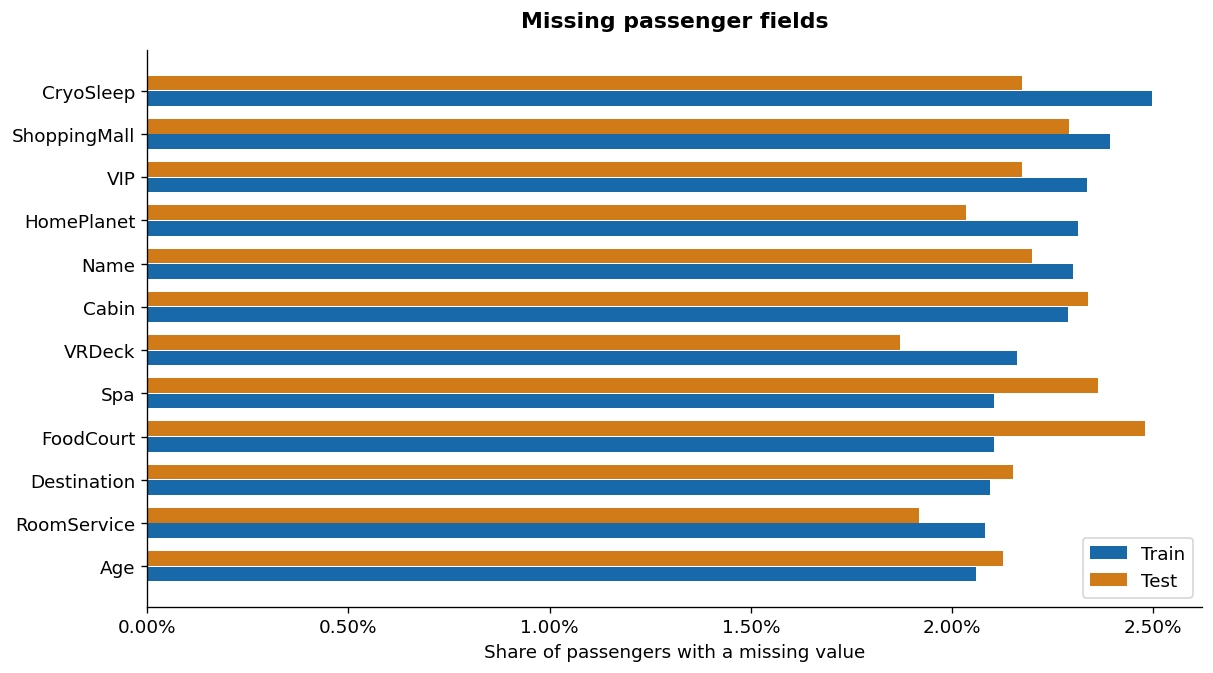
Missing values affect roughly 2–2.5% of passengers per displayed field, with broadly similar rates in train and test. A blank spa bill is not evidence of a free massage. The pipeline preserves missingness and distinguishes unknown expenditure from confirmed zero spending.
The receipts survived the wormhole
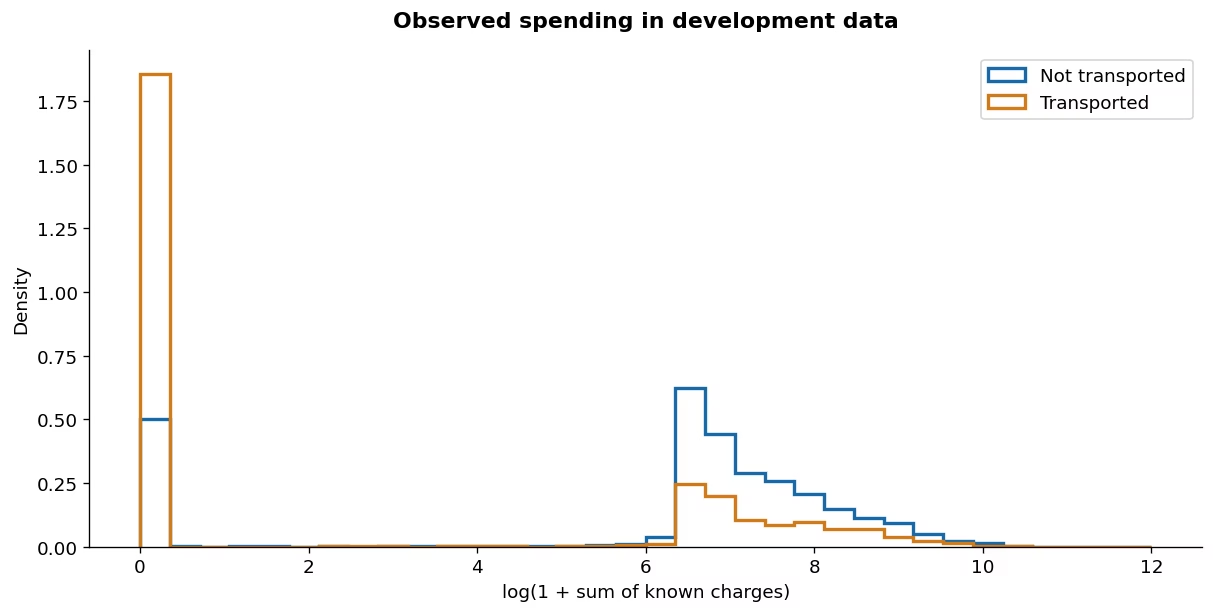
The spending chart shows a striking concentration of transported passengers near zero observed expenditure. Its horizontal axis is logarithmic; the curves are densities, not passenger counts. Cryosleep offers a plausible connection: sleeping travellers have fewer opportunities to run up a bar tab. But this is an association in a synthetic dataset. Cancelling room service is not a scientifically established defence against interdimensional travel.
Accuracy is the headline. The confusion matrix is the incident report.
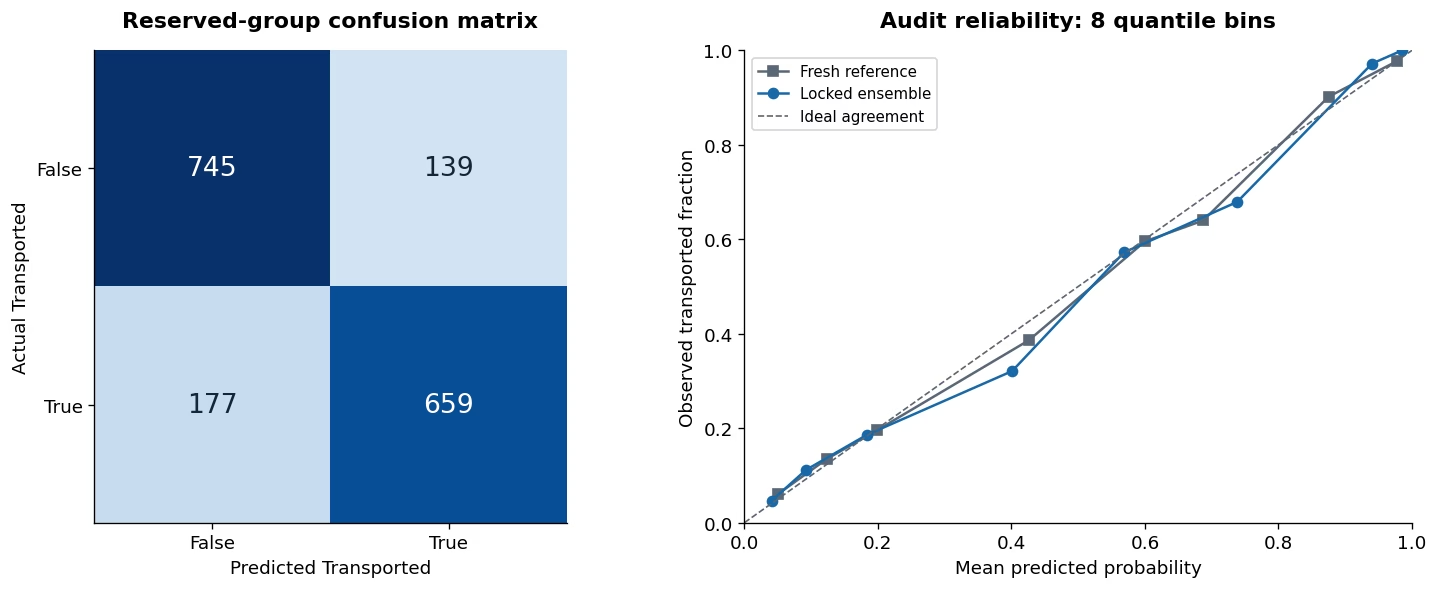
The ensemble correctly classifies 1,404 of 1,720 audit passengers: 745 who stayed and 659 who were transported. It raises 139 false alarms and misses 177 transported passengers—about 78.8% recall for the transported class. A respectable score still leaves names missing from the rescue list. The reliability plot asks whether predicted probabilities match observed frequencies. Its curves broadly follow the diagonal, with visible departures: confidence deserves inspection as much as correctness.
Why is the spa in the interrogation room?
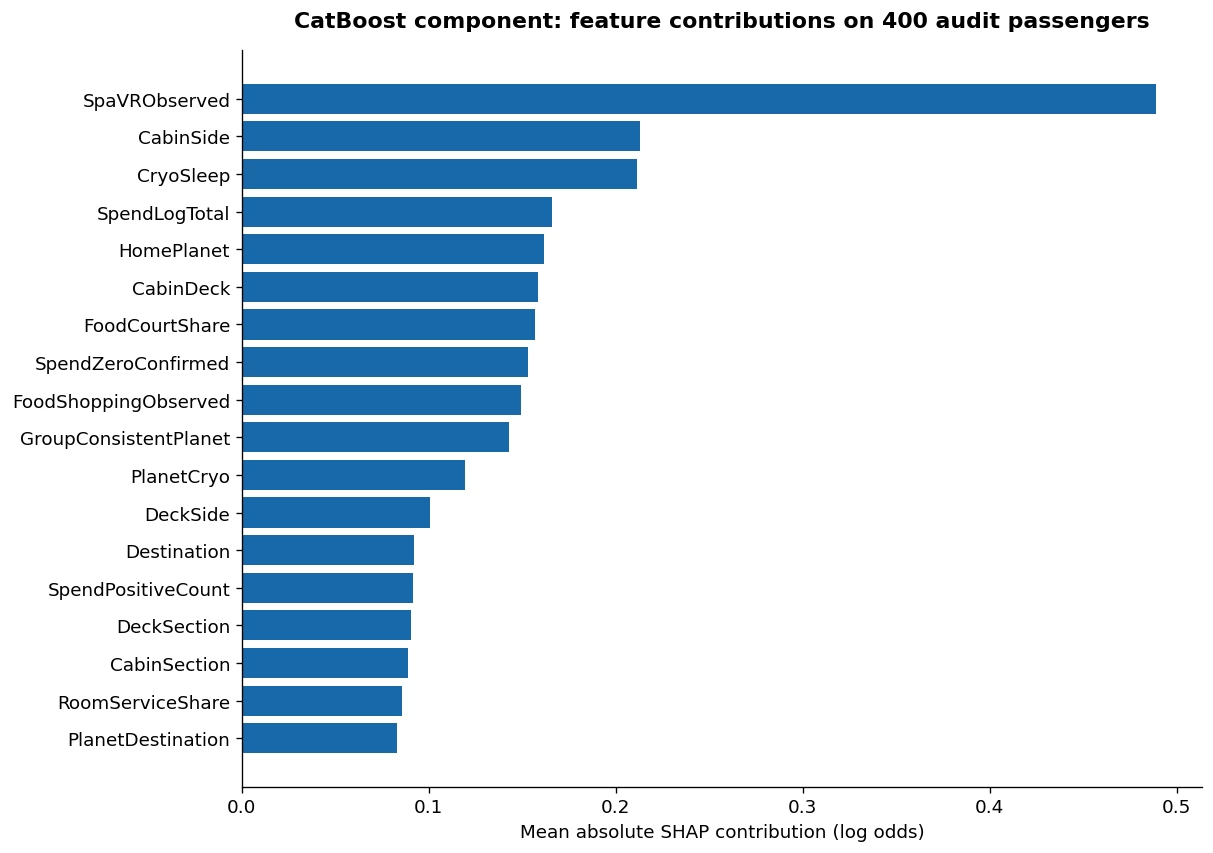
The SHAP chart ranks SpaObserved first among the displayed contributions for one CatBoost component, followed by cabin side, cryosleep, and total spending. These are mean absolute contributions on 400 audit passengers: they measure strength, not direction, and do not establish causation. The spa is a useful witness. We have not established it as the perpetrator.
Keep the scores in their own orbits
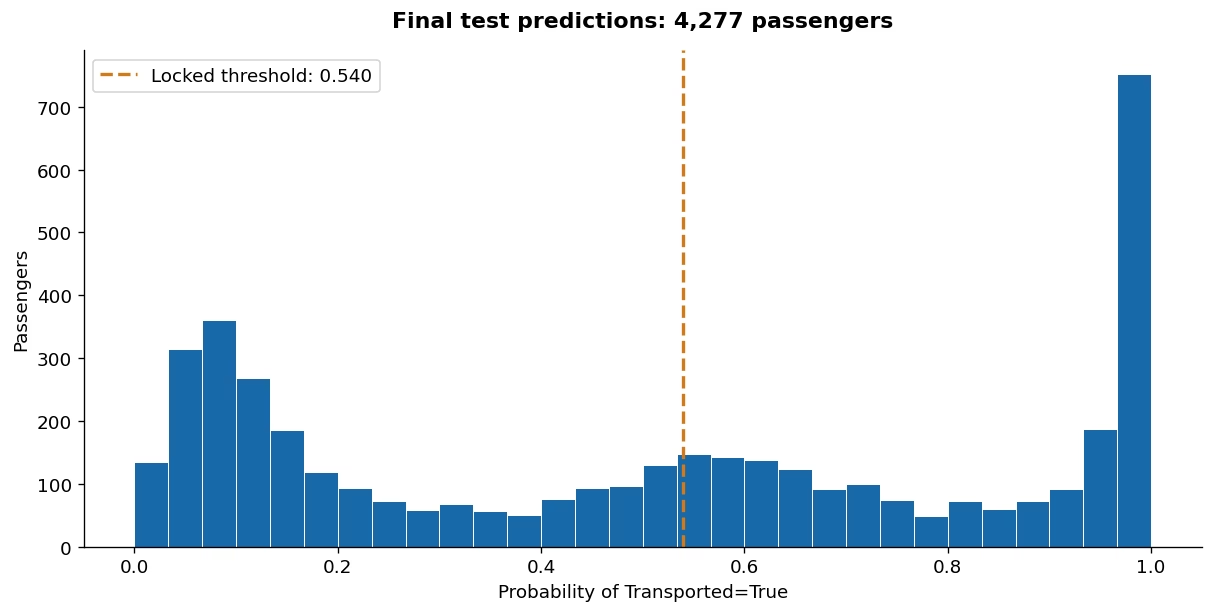
The final histogram covers 4,277 test passengers. At the locked threshold of 0.540, 48.28% are predicted as transported. Full-training out-of-fold accuracy is 80.996%, with ROC AUC 0.90403; these are selection-affected diagnostics. Kaggle displays a public score of 0.80056, separate from the reserved audit. Putting all three numbers on the same podium would make the story tidier and the science worse.
The most useful upgrade is an experiment that leaves a trail: splits, tuning history, probabilities, explanations, and saved models that reproduce the test predictions. We still cannot repair a wormhole. We can at least stop our validation procedure from opening one.
Spachip Titanic with Catboost Classifier – Kaggle Notebook
Reconstructing the Spaceship Titanic: a city between the stars
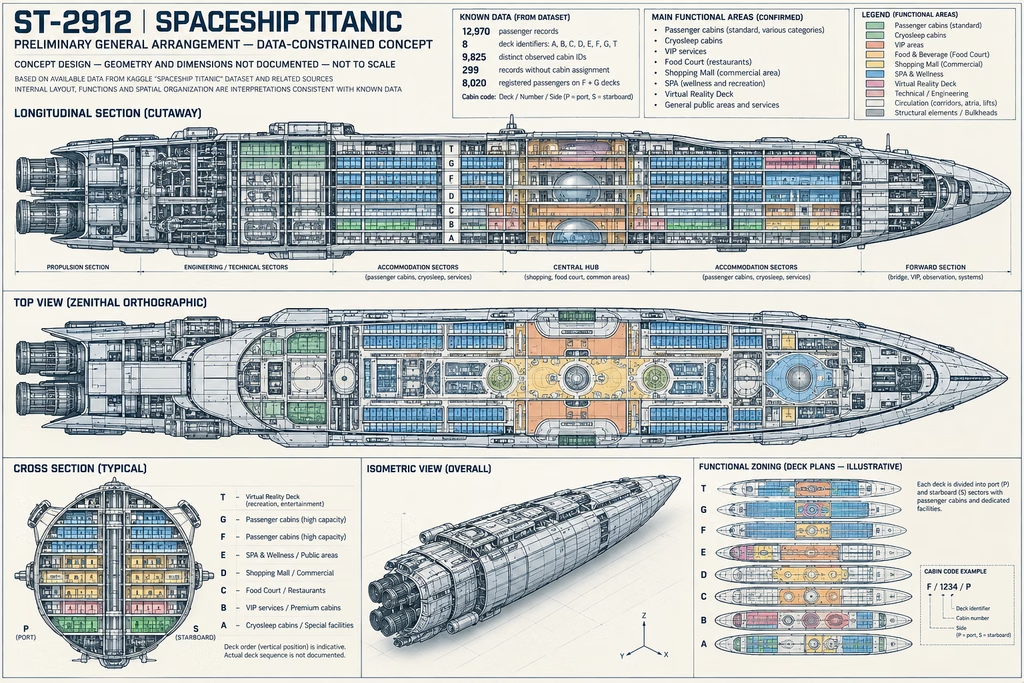
After asking an algorithm to find the missing passengers, I wanted to give them somewhere to come back to. So I asked ChatGPT to work backwards: take the surviving clues from the competition, put on an imaginary engineering badge, and sketch the ship that might have carried them. From a passenger manifest to a vessel; from rows and columns to decks and corridors. A small act of reverse engineering, with a rather ambitious target platform: the year 2912.
The dataset gives us fragments of a world: cabin codes, deck letters, port and starboard, travelling groups, cryosleep, destinations, and bills for food, shopping, the spa, and virtual reality. It gives us no shipyard drawings. The hull geometry, dimensions, propulsion layout, deck arrangement, and placement of facilities in this image are therefore design assumptions, not recovered specifications. The result is a concept constrained by those clues, not a uniquely deduced spacecraft. There is no secret column called EngineBlueprint.
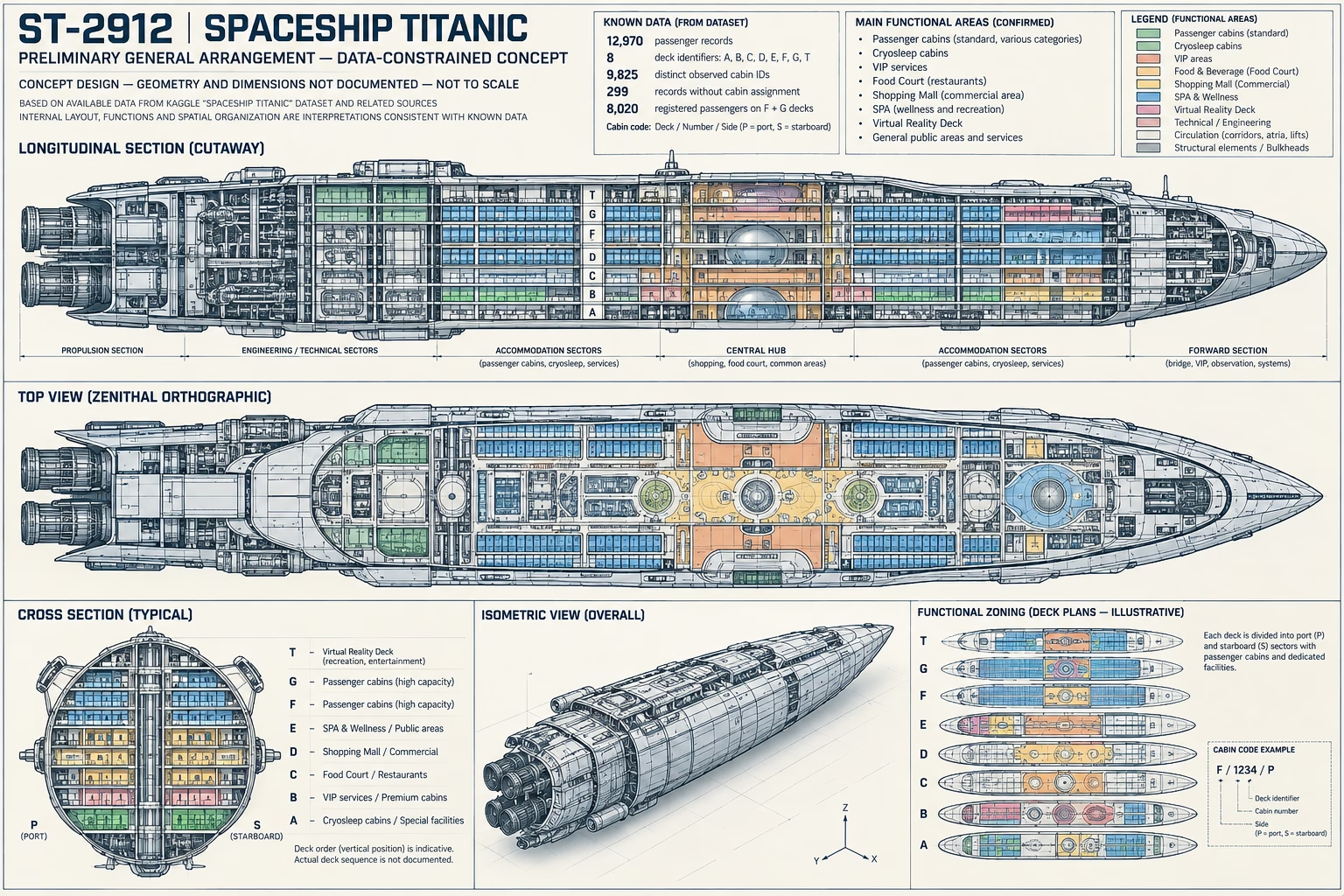
A spreadsheet, given corridors
Read the cutaway as a proposed answer to a question: what kind of place could contain these records? The longitudinal section opens the hull like a patient debugger opening a stack trace. The top view, cross-section, and deck sketches let us walk around the same idea. Colours separate functions; repeated compartments turn anonymous cabin identifiers into somewhere a person might leave a suitcase. The drawing offers spatial coherence, while its fine labels and apparent precision still need the same sceptical eye we brought to the model.
In this imagined arrangement, the ship becomes a travelling neighbourhood. Somewhere, a sleeper has entrusted an entire journey to a closed lid. Elsewhere, someone has ordered dinner, bought something unnecessary, or paid to enter a virtual world while already crossing a real one. Humanity has reached the stars and brought the shopping mall. Of all the speculative technologies on this page, that may require the least suspension of disbelief.
The universe has not signed off on the design
An engineering drawing also invites gloriously inconvenient questions. How would people evacuate? Where would maintenance crews reach a failed subsystem? What supplies the power, handles the heat, and keeps thousands of passengers alive? The illustration prompts those questions; it does not solve them. Its engines have not passed a propulsion review, its structure has not been validated, and neither the dataset nor a handsome cutaway grants faster-than-light travel a building permit. The universe remains an unusually strict code reviewer.
That is what makes the reconstruction worth doing. Each attempt to give the ship a shape exposes another assumption that a tidy table can hide. A cabin becomes a location; a group becomes people travelling together; a missing value becomes a hole in the surviving record. The classifier and the drawing meet here: both build a model from incomplete evidence, and both become more interesting when we can see where the evidence ends.
I like to imagine the Titanic in the instant before the anomaly: lights burning along its corridors, a meal cooling on a table, thousands of sleeping passengers carrying private versions of tomorrow. Then spacetime throws an exception nobody caught. We are left with a manifest, a few receipts, and the stubborn urge to make sense of them. Somewhere between a CSV file and a constellation, a row becomes a passenger again.
