
Nature seems to follow a recurring rule: the most extraordinary things are never centralized.
A brain is not one gigantic neuron.
A flock is not a single bird leading the others.
A swarm, an ecosystem, an ant colony: they all emerge from the cooperation of many simple entities.
Computer science, in many ways, has followed the same path.
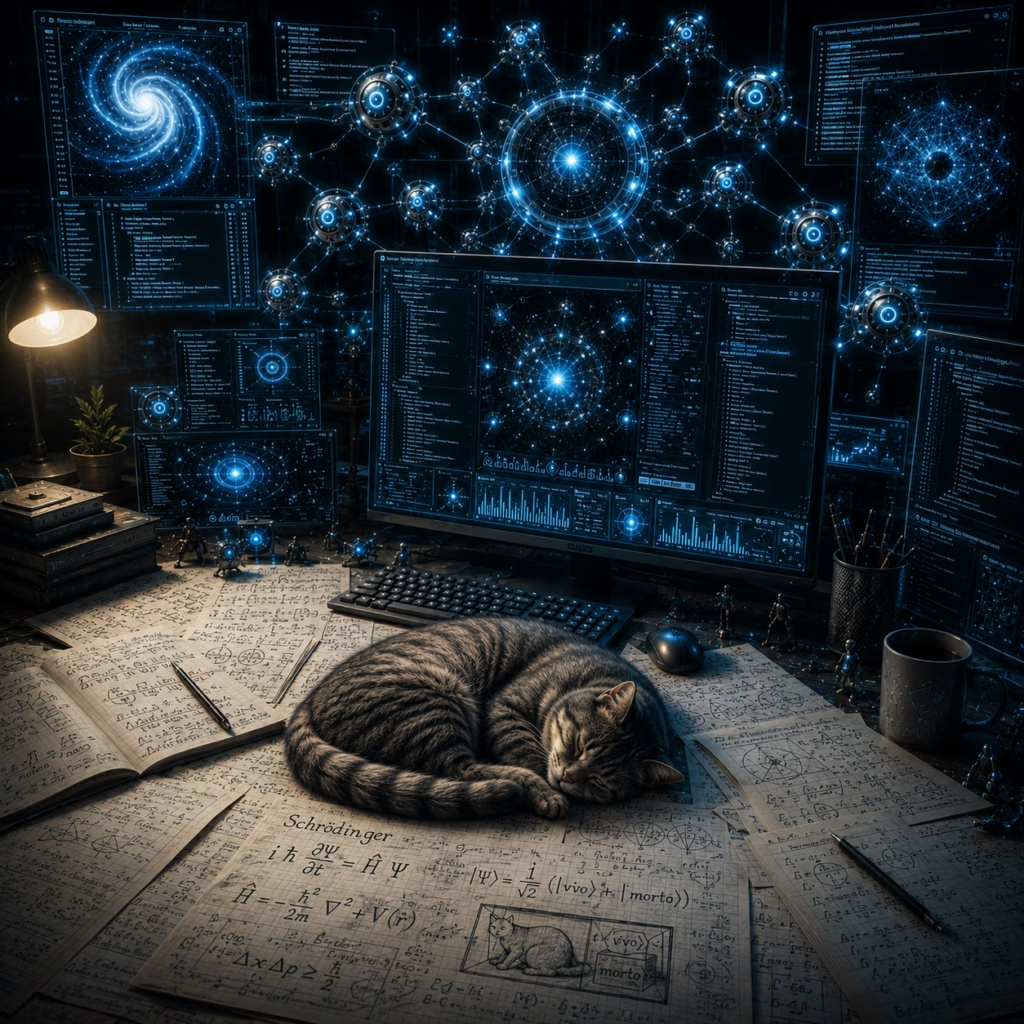
For years we built software as massive monoliths. Then microservices arrived, teaching us that distributing responsibilities often makes systems more flexible, resilient, and ultimately more intelligent.
Perhaps that is why the agentic paradigm fascinates me so much.
I have always loved distributed systems. Back at university, I designed an architecture for highly parallel and distributed genetic algorithms (aimed at optimizing and training neural networks), where independent populations evolved on virtual “islands” and “archipelagos,” periodically exchanging individuals to accelerate the search for better solutions.
Even then, I was captivated by a simple idea:
Many limited entities, cooperating together, can produce a form of collective intelligence that is far greater than the sum of its parts.
Today, artificial intelligence is undergoing the same transformation.
After the era of monolithic generative models, we are witnessing the rise of agentic architectures: teams of specialized agents collaborating toward a common goal. One gathers information, another validates it, another organizes it, and another assembles the final result.
Not a single mind.
A small society of minds.
To explore this paradigm, I built a personal experiment using CrewAI: a crew of cooperative agents capable of generating financial reports starting from nothing more than an ISIN (International Securities Identification Number) and Ticker.
The beauty of this swarm is that its intelligence lives in the architecture, not in any single model: the same crew can run on a frontier engine like GPT-5.5 or Claude Opus 4.8, or on far more frugal tiers like GPT-5.4 Mini, Claude Haiku 4.5 or DeepSeek — trading a little narrative finesse for a dramatically lower bill.
The project is still very much a work in progress. My next step is to extend it with a daily watchlist report, where a team of specialized agents will continuously monitor the stocks and ETFs I follow, collecting market data, news, trends, and insights to produce a personalized daily briefing.
The project began as an exercise inspired by Ed Donner‘s excellent Udemy course, AI Engineer Agentic Track: The Complete Agent & MCP Course, but it quickly became something more: a way to revisit, with today’s AI technologies, those same ideas of distribution and cooperation that have fascinated me since my university days.
Perhaps it was inevitable.
The evolution of computer science seems to follow the same direction over and over again:
from the monolith to cooperation.
Once you cross the threshold into the world of agentic architectures, there is no turning back. My mind is already overflowing with ideas to explore.

Ciao Luca ho letto il tuo post sugli agenti cooperativi — mi ha colpito molto, perché stiamo lavorando sulla stessa idea da angolazioni diverse.
Anch’io ho costruito un sistema multi-agente per l’analisi finanziaria, ma con il Claude Agent SDK invece di CrewAI: un “war room” con agenti specializzati (macro-intel, portfolio-analyst, risk-sentinel, opportunity-hunter, strategist) che collaborano attraverso un workspace condiviso in markdown. L’orchestrazione è conversazionale, meno strutturata di CrewAI ma sorprendentemente efficace.
La tua analogia con gli algoritmi genetici a isole è esatta — l’intelligenza emerge dall’intersezione delle prospettive, non da un modello monolitico che sa tutto.
La daily watchlist report che stai pianificando è esattamente il passo successivo che ho fatto anch’io: ho una routine schedulata che gira ogni mattina alle 8:30 e manda uno snapshot su Telegram.
E’ un piacere sentirti. Voglio cambiare la tipologia di report per arrivare più ad una daily watchlist e prevedere un invio periodico via telegram.
ho implementato e pubblicato su github la daily watchlist con 5 agenti.
Bravo Luca, complimenti. Anche a me sono sempre piaciuti i sistemi distribuiti, del resto ho fatto una tesi sugli automi cellulari. 🙂 Mi sa che ti seguo ed implemento anche io qualcosa per divertirmi 🙂